
Unbleached cotton canvas bags combine a natural-looking fabric surface with a large printable area and practical everyday use. For souvenir shops, museums, visitor attractions, hotels and destination retailers, that combination makes the tote bag more than packaging: it can become a portable city souvenir that continues to display the destination after the trip.
The product may look simple, but a reliable wholesale order depends on several connected decisions. Fabric composition, actual weight, finished size, gusset depth, handle measurement, sewing, print area, ink coverage, sample approval, bulk packing and freight method all affect the final result and landed cost.
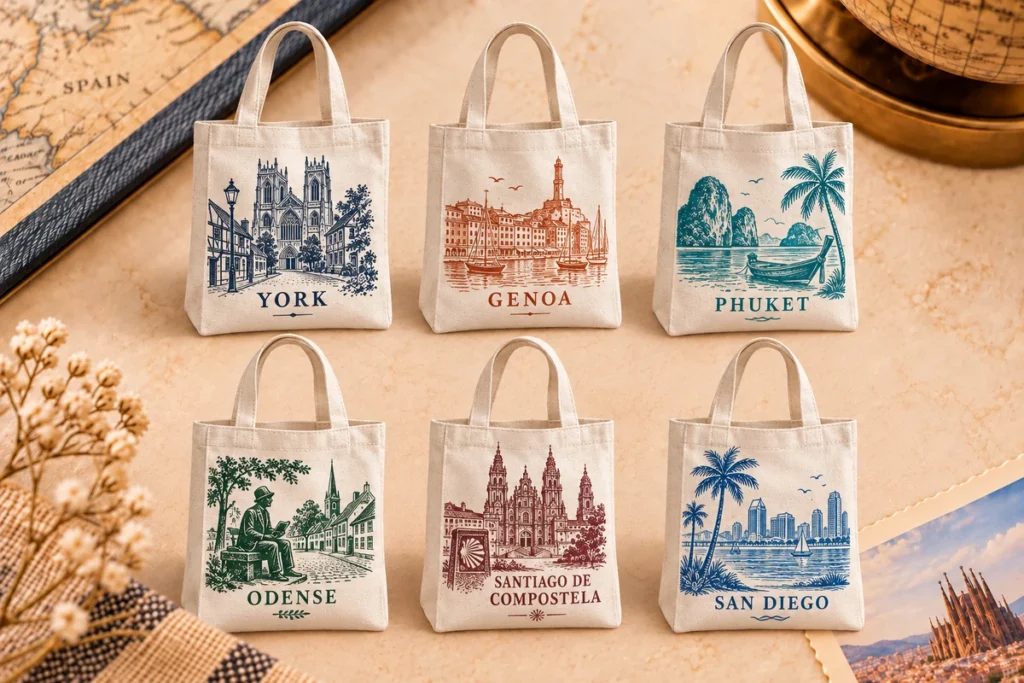
This guide explains those decisions for buyers developing custom canvas tote bags for tourism retail. It also shows how one natural cotton bag format can support very different destination stories through examples inspired by York, Genoa, Phuket, Odense, Santiago de Compostela and San Diego. Buyers planning broader branded campaigns can also compare our custom logo canvas tote bags for promotional programs.
What Are Unbleached Cotton Canvas Bags?
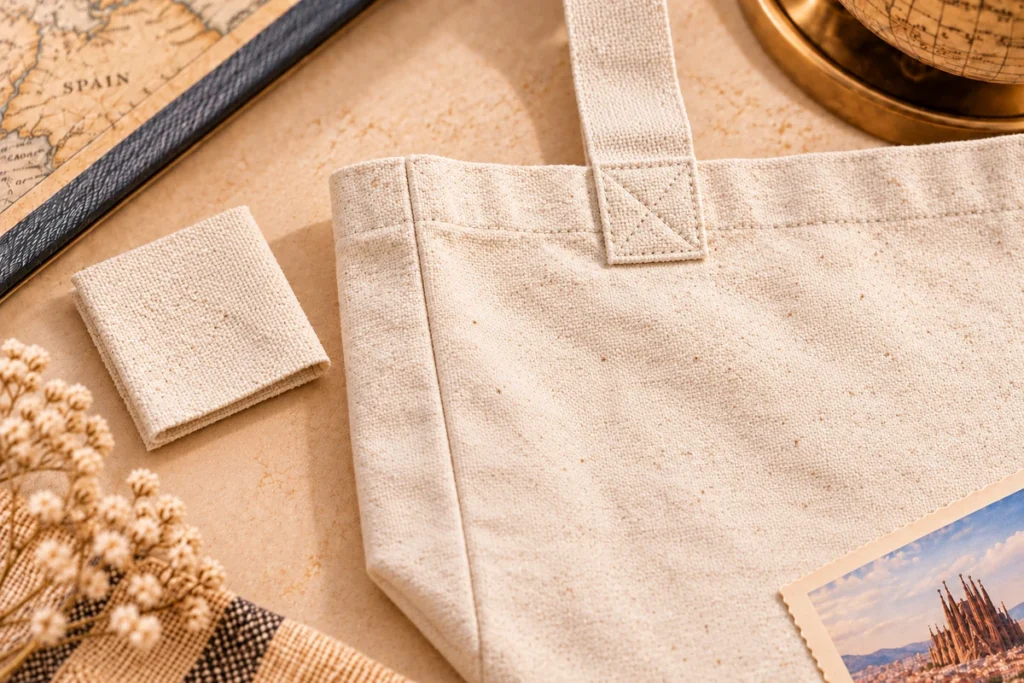
Unbleached cotton fabric has not been chemically whitened to create a bright white appearance. It normally retains a warm natural, oatmeal or light-cream tone. Small cotton-seed flecks, subtle fiber variation and minor shade differences may remain visible.
These characteristics are not automatically defects. They are part of the natural appearance buyers often want when selecting an unbleached bag. However, the approved sample should define the acceptable shade, surface texture and level of visible flecking because different fabric lots may not look identical.
The word canvas describes a woven fabric structure and commercial product category, but suppliers and buyers sometimes use it loosely. A lightweight cotton shopping bag, cotton calico bag and heavier cotton canvas tote may all be described as a canvas bag in casual conversation. The quotation should therefore state the actual fiber composition, weave, weight and approved hand feel instead of relying only on the word “canvas.”
Why Natural Cotton Tote Bags Work for Tourism Retail
Natural cotton tote bags offer several advantages for destination merchandise:
- A neutral fabric color supports line art, maps, typography and one-color landmark illustrations.
- A large front panel can display a city name and recognizable visual story.
- Flat or bulk-packed bags use retail and storage space efficiently.
- Handles and gussets can be adapted to books, museum purchases, food products and everyday shopping.
- One standardized bag construction can support several city or attraction designs.
- The product can coordinate with postcards, notebooks, maps, apparel and other destination merchandise.
Reusable does not automatically mean environmentally superior in every situation. Fiber sourcing, fabric processing, printing, production yield, packaging, transport and the number of actual uses all affect environmental impact. Unless documented certification is available, buyers should avoid describing ordinary unbleached cotton as organic, recycled, certified sustainable or zero-impact.
Fabric Weight: What Does 140 GSM or 4 oz Mean?
Fabric weight is commonly expressed in grams per square meter (GSM) or ounces per square yard. A specification of 140 GSM is approximately 4.1 oz/yd², although rounding and measuring methods can create small differences.
For a simple foldable tote, 140 GSM can provide a lightweight construction. It may be suitable for destination retail, events and general carrying when the bag design and seams are appropriate. It should not automatically be described as heavy-duty. A bag intended for books, bottles or other dense merchandise may require a heavier fabric, reinforced stress points or a different construction.
Buyers should request a real fabric swatch or sample and evaluate:
- opacity and show-through;
- surface texture and visible cotton flecks;
- print sharpness and ink penetration;
- shrinkage or distortion where relevant;
- seam stability and handle attachment;
- the weight and shape of the intended contents.
Buyer Inquiry Example: 3,000 Custom Unbleached Cotton Bags
A recent buyer inquiry requested approximately 3,000 custom unbleached cotton bags with a one-color logo print and quotations for both air and ocean delivery to a destination in the western United States. The customer identity and exact delivery address are omitted here, but the specification is useful because it shows the level of detail required for a meaningful wholesale and fully landed quotation. It is a real inquiry example, not a universal product standard.
| Specification | Example requirement | What still needs confirmation |
|---|---|---|
| Quantity | 3,000 bags | Quantity per artwork and acceptable over/under tolerance |
| Finished size | 14 in wide × 16 in high | Measuring method and production tolerance |
| Gusset | Side and bottom gussets | Exact depth: 2, 3 or 4 inches |
| Material | Unbleached cotton or cotton canvas | Composition, weave, weight and approved sample |
| Fabric weight | 140 GSM, approximately 4 oz/yd² | Actual tested or nominal weight tolerance |
| Color | Natural or light cream | Approved shade range and cotton-seed fleck appearance |
| Handles | Approximately 24–28 inches | Total handle length, width and finished drop |
| Printing | One-color screen print on one side | Artwork, Pantone reference and ink coverage |
| Print area | Approximately 9 × 9 inches | Exact placement measured from bag edges |
| Packaging | Bulk packed | Fold method, pieces per inner pack and carton limits |
| Delivery | Air and ocean options | Required arrival date and delivery conditions |
| Quotation | Fully landed delivery | Incoterm, duties, address type and unloading needs |
| Sample | Printed sample before order | Sample cost, courier charge and approval schedule |
This type of specification helps a supplier prepare a useful quotation, but unresolved ranges should be converted into exact choices. A 2-inch gusset and a 4-inch gusset do not have the same fabric consumption, capacity or carton volume. Likewise, a 24-inch handle and a 28-inch handle can sit differently on the shoulder.
Developing Destination Artwork: Six City Concepts
A tourism tote should do more than place a city name on a generic bag. The artwork should select recognizable elements, simplify them for the print method and create a composition that remains legible from a normal viewing distance.
The following city directions demonstrate how one unbleached cotton bag can support several tourism identities without changing the basic construction.
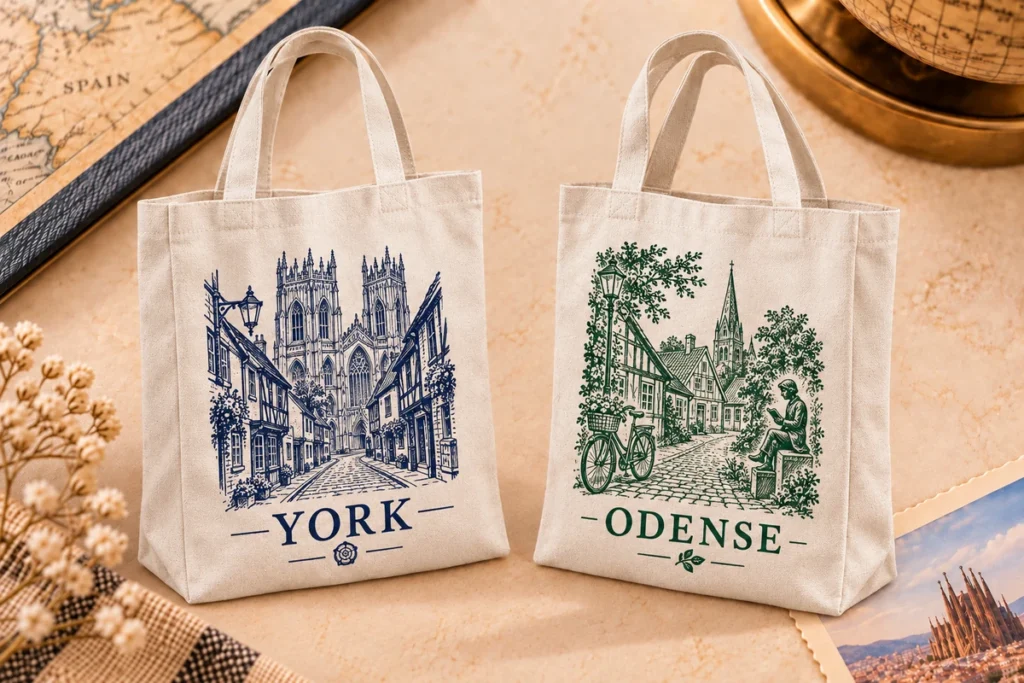
York, United Kingdom: Historic Streets and Gothic Architecture
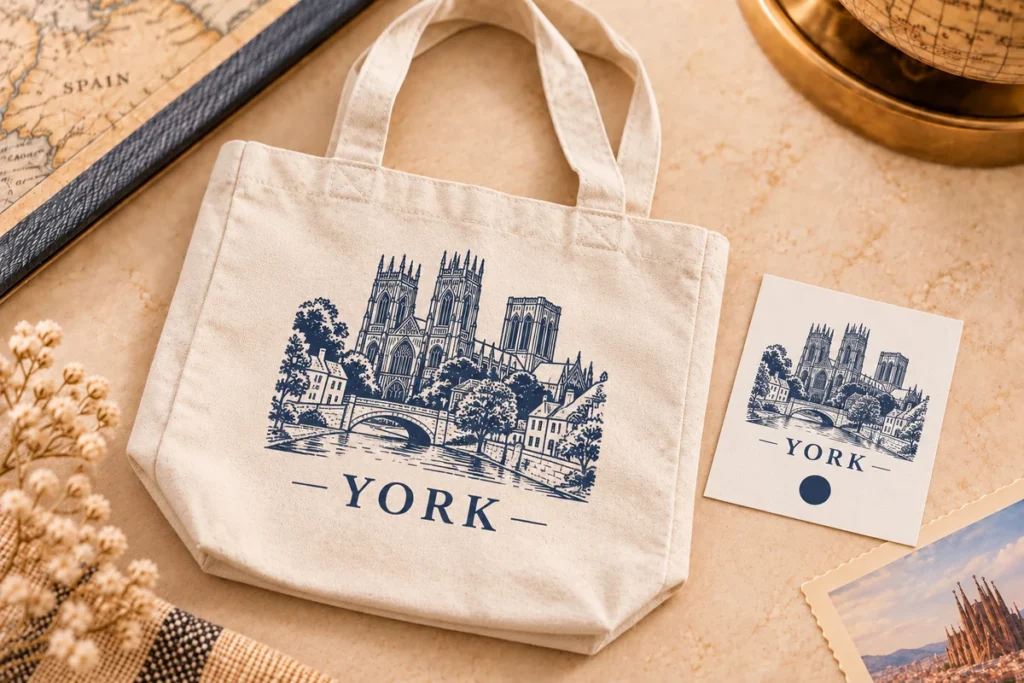
York supports an architectural approach built around the Minster skyline, medieval streets, city walls and traditional shopfronts. A one-color navy, charcoal or deep burgundy print can suit the natural fabric while maintaining a heritage atmosphere.
The artwork should avoid overcrowding every attraction into one illustration. A strong option is a central cathedral silhouette with a simplified street or wall motif below it, supported by a clear YORK wordmark. Fine window and stone details must be adjusted to the real screen mesh and print size.
Odense, Denmark: Storytelling and Scandinavian Simplicity
Odense can use a lighter Nordic visual language: compact historic buildings, bicycles, storybook-inspired lines and restrained typography. The design can feel different from York even when both bags use the same natural fabric and one-color printing.
For a coordinated European collection, York and Odense could share the same bag size, handle length and print position while using separate artwork and ink colors.
Genoa, Italy: Maritime Heritage and Port-City Layers
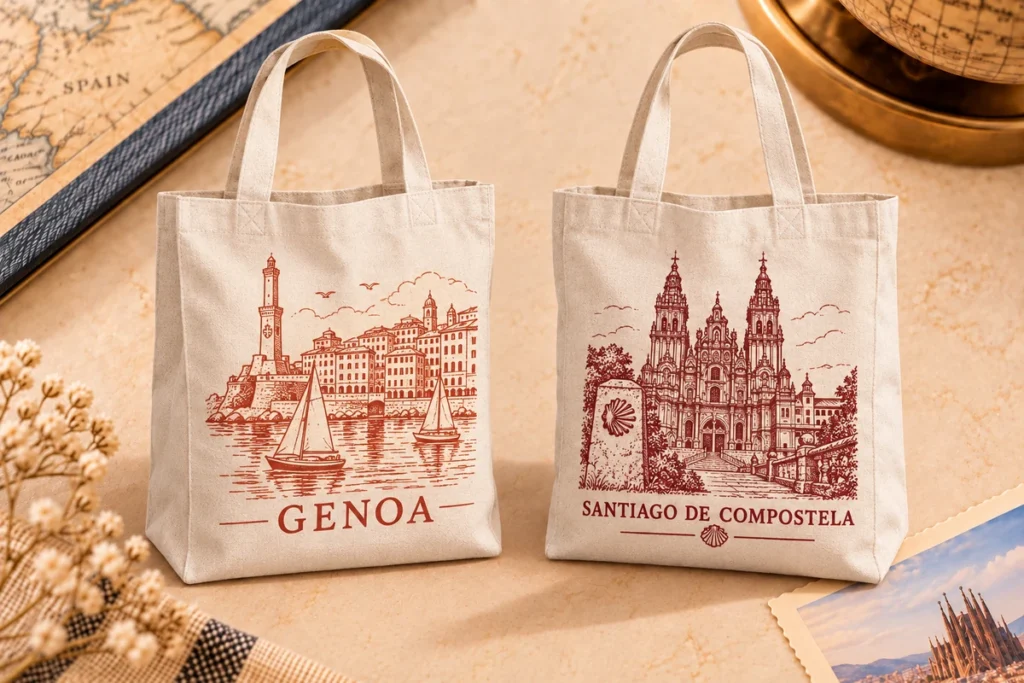
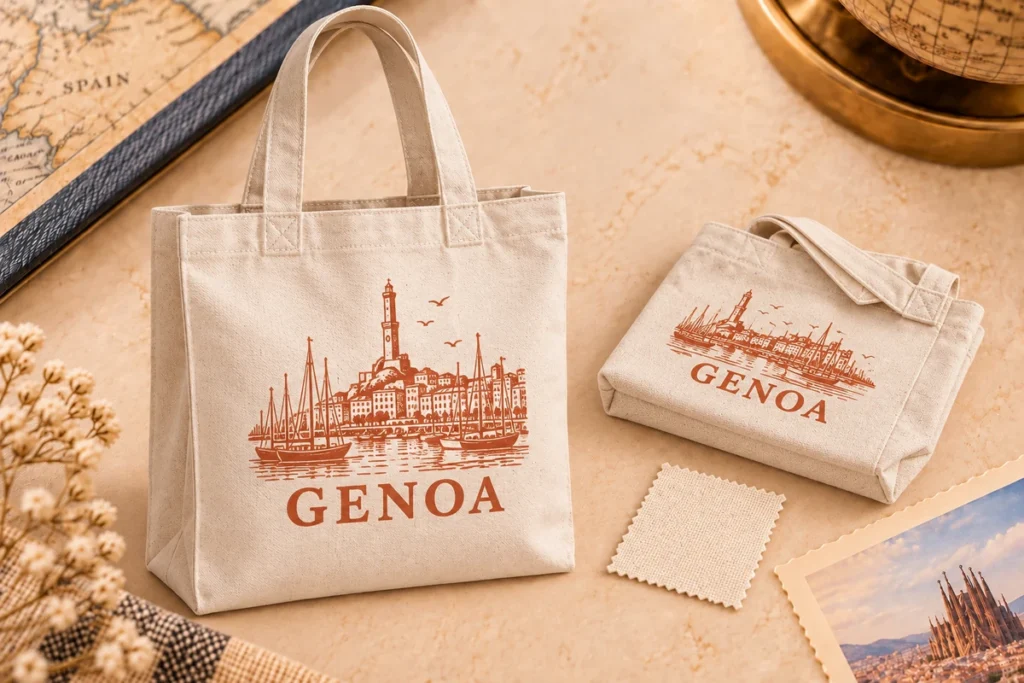
Genoa offers a maritime direction based on its waterfront, lighthouse, old port, narrow streets and layered hillside buildings. Deep blue or terracotta ink can work effectively on a natural cotton surface.
A tourism design might combine a bold lighthouse or harbor line with smaller architectural shapes. Buyers should ensure that the artwork is original or properly licensed rather than copying a photograph or existing retail graphic without permission.
Santiago de Compostela, Spain: Pilgrimage Symbols and Stone Architecture
Santiago de Compostela can use the cathedral façade, an abstract route line, scallop-shell imagery and restrained historic lettering. Because the scallop shell is widely associated with the pilgrimage route, the final artwork should still be custom developed rather than copied from another supplier’s design.
For a one-color screen print, the cathedral should be simplified into areas that can reproduce cleanly. Small stone carvings and dense shading may need to be converted into bolder lines or controlled halftones.
Phuket, Thailand: Tropical Coast and Island Color
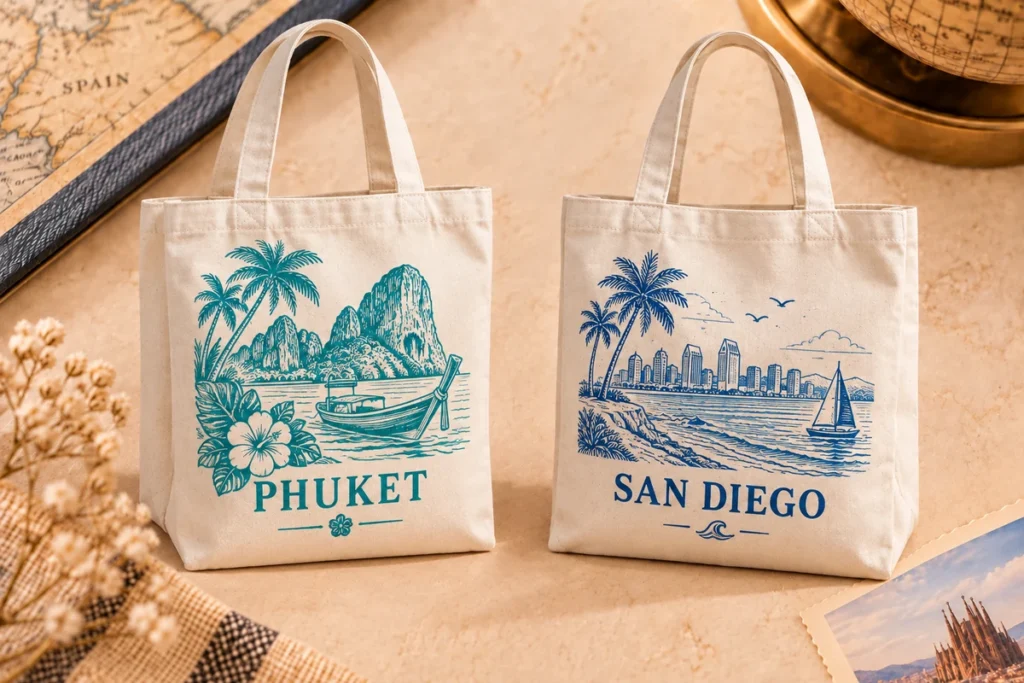
Phuket can move beyond a generic palm-tree graphic by combining island coastline, long-tail boat shapes, waves and selected Sino-Portuguese architectural references. A turquoise, ocean blue or warm coral ink can create a more leisure-oriented identity.
If the bag will be sold in different areas of Phuket, the retailer may choose one island-wide design or several location-specific versions. Quantity per design matters because splitting 3,000 bags across many artworks may change printing setup and unit pricing.
San Diego, United States: Coastal Lifestyle and Urban Landmarks
San Diego can combine coastline, sailboats, a simplified skyline, palms and selected architectural references. A clear one-color design can feel contemporary rather than relying on a dense photographic collage.
Phuket and San Diego are both coastal destinations, but their artwork should not become interchangeable. The illustration needs a city-specific landmark structure, typography and visual rhythm so each bag remains recognizable.
Choosing the Right Bag Construction
Flat Tote or Gusseted Tote
A flat tote uses less material and folds compactly. A gusseted tote creates extra capacity and a more defined base. Side gussets, a bottom gusset, or both can be used, but the exact finished depth must be stated.
For tourism retail, gussets can help when customers carry books, packaged food, museum purchases or multiple souvenirs. They also affect how the front panel sits when the bag is filled, so the print should be positioned on the usable front area rather than too close to a fold.
Handle Length and Shoulder Carrying
Handle specifications can be misunderstood. “24-inch handles” may refer to the total cut or finished loop length, not a 24-inch vertical drop. A technical drawing should show the measuring method, handle width, attachment position and finished drop.
Long handles support shoulder carrying, but they should remain proportionate to the bag. Handle attachment should be tested with the intended load, and reinforced stitching can be considered when the use case requires it.
Seam and Stress-Point Details
The buyer should confirm seam type, stitch density, thread color, turned or bound internal edges and handle reinforcement. A sample should be loaded with representative contents and inspected for seam opening, distorted panels and handle movement.
Screen Printing a One-Color Destination Design
One-color screen printing is suitable for bold city illustrations, logos and typography. It can be cost-efficient for a 3,000-piece order, but the result depends on artwork preparation and fabric behavior.
For an approximately 9 × 9-inch print area, buyers should confirm:
- exact artwork dimensions;
- placement from the top and side edges;
- distance from gusset folds and seams;
- solid coverage versus fine lines or halftones;
- ink color or Pantone reference;
- print opacity on the natural fabric;
- curing, adhesion and rub performance;
- acceptable registration and placement tolerance.
The same file should not be used automatically for every city. York’s Gothic linework, Genoa’s harbor shapes, Phuket’s tropical curves and San Diego’s skyline may require different line weights even when the final print dimensions are identical.
Sampling Before a 3,000-Piece Order
A printed pre-production sample gives the buyer an opportunity to confirm the complete bag rather than approving fabric and artwork separately.
The sample review should cover:
- finished width, height and gusset depth;
- fabric color, weight and hand feel;
- handle length, width and attachment;
- seam construction and internal finishing;
- print size, position, color and edge definition;
- bag shape when empty and when loaded;
- folding and bulk-packing method;
- carton dimensions and expected quantity per carton.
A printed sample may have a separate sampling charge and courier cost. Buyers should ask whether any sample fee can be credited after a bulk order, but that arrangement should be confirmed in the quotation rather than assumed.
Bulk Packing, Air Freight and Ocean Freight
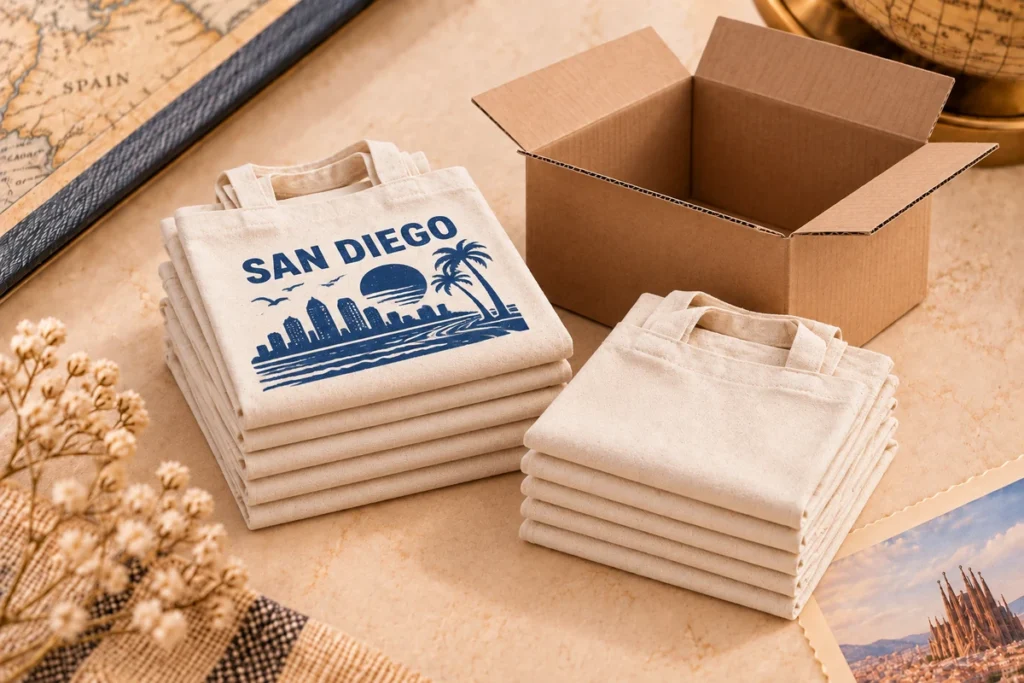
Bulk packing without individual retail bags can reduce packaging materials and carton volume, but the folding method still needs approval. Printed panels should not rub excessively against hardware, dirt or wet surfaces during packing and transport.
For a delivered quotation, buyers should confirm whether the price is EXW, FOB, CIF, DAP or DDP. The phrase “fully landed price” is often used to request a delivered total, but the quotation should explicitly state which charges are included, the destination type and who is responsible for duties, taxes, customs clearance and unloading.
Air freight generally supports shorter transit planning but can be expensive for bulky textiles. Ocean freight can lower transportation cost per bag at larger volumes, but the shipment also requires origin handling, ocean transit, destination processing and inland delivery. A meaningful comparison should include:
- production completion date;
- chargeable weight or shipment volume;
- carton quantity and dimensions;
- port and destination routing;
- customs and duty assumptions;
- residential, commercial or warehouse delivery;
- liftgate, appointment or limited-access needs;
- estimated rather than guaranteed transit timing.
For more detail on packaging decisions, read our custom product packaging guide.
What Determines the Cost Per Bag?
The final unit price is affected by more than the quantity. Important cost variables include:
- fabric composition, weave and weight;
- finished dimensions and gusset depth;
- handle material, width and length;
- seam construction and reinforcement;
- number of artwork versions;
- print method, size, colors and ink coverage;
- sample requirements;
- bulk or individual packaging;
- inspection requirements;
- carton volume and shipment weight;
- air, ocean, courier or combined transport;
- destination and delivery conditions.
That is why a supplier usually cannot provide a reliable fully landed unit price from quantity alone. A detailed specification, artwork file, exact address type and required delivery date are needed before product cost and freight can be combined.
How to Choose a Canvas Tote Bag Supplier
A suitable supplier should be able to translate commercial descriptions into measurable specifications. Before ordering, ask how the supplier will control fabric weight, bag dimensions, handle measurement, print placement and packing.
Yiwu Superstar works as a custom souvenir supplier and sourcing partner. We coordinate appropriate production resources, sampling, production follow-up, quality control, packaging and shipment through one point of contact. Buyers can review our China sourcing partner checklist and one-stop sourcing guide before starting a project.
For destination retailers building a wider range, see our guides to custom tourist souvenirs and museum and attraction souvenir collections. Brands and event buyers can also explore custom promotional gifts and our one-stop sourcing service.
Frequently Asked Questions About Unbleached Cotton Canvas Bags
1. What is the difference between natural cotton and unbleached cotton?
Natural cotton is often used as a color description, while unbleached cotton describes fabric that has not been chemically whitened. A supplier should confirm the actual processing, composition and approved color rather than relying only on a marketing term.
2. Is cotton canvas the same as a lightweight cotton tote fabric?
Not always. Canvas normally refers to a durable woven construction, but the term may be used broadly. Buyers should confirm composition, weave, GSM or oz/yd², thickness and hand feel with a real sample.
3. Is 140 GSM suitable for a canvas tote bag?
140 GSM can suit a lightweight foldable tote, depending on dimensions, seams, handles and intended contents. It should not automatically be described as heavy-duty. Bags intended for dense or heavy goods should be tested with representative loads.
4. Which printing method is suitable for one-color city artwork?
Screen printing is a common option for bold one-color illustrations and larger quantities. Fine details, halftones, ink coverage and print size should be reviewed against the real fabric and approved through a printed sample.
5. Can the same tote bag be used for several destinations?
Yes. Buyers can standardize the material, size, gussets, handles and print position while changing the destination artwork. Quantity per city still matters because each artwork may require separate screens, setup and production control.
6. What is the MOQ for custom unbleached cotton bags?
MOQ depends on fabric availability, bag construction, print method, number of designs and packaging. A 3,000-piece project can often be divided among several city designs, but the minimum quantity per artwork must be confirmed before quotation.
7. Can I receive a printed sample before bulk production?
Yes, a printed sample can normally be arranged after the fabric, construction and artwork are confirmed. Sampling cost, courier cost, sample timing and whether a fee is credited toward the bulk order should be stated in the quotation.
8. How should shoulder-handle length be specified?
State whether the measurement is the total finished handle length or the vertical handle drop. Also specify handle width, spacing and attachment method. A technical drawing prevents confusion between 24-inch and 28-inch handle descriptions.
9. Should buyers choose air freight or ocean freight for 3,000 bags?
The decision depends on carton volume, required arrival date, budget and destination. Air freight usually supports shorter timelines, while ocean freight may reduce transport cost for bulkier orders. Compare complete delivered quotations rather than freight charges alone.
10. What information is needed for a fully landed quotation?
Provide quantity, finished size, exact gusset depth, fabric composition and weight, handle dimensions, artwork, print size and color, packaging, sample requirement, delivery address type and required date. Specify whether the quotation should include duties, taxes, customs clearance and final delivery. Contact Yiwu Superstar to discuss your project.
Plan Your Custom Canvas Souvenir Bag
Send us your bag dimensions, fabric preference, city artwork, quantity per design, printing requirements, packaging and delivery destination. We can coordinate sampling, production, quality control and air or ocean freight options.