Introduction
MOQ for custom plush toys is one of the first questions buyers ask when sourcing plushies, stuffed animals, plush mascots or plush keychains from China.
For many B2B buyers, the question sounds simple:
“How many pieces do we need to order?”
But in custom plush production, MOQ depends on many details. The design, fabric, size, embroidery, printing, accessories, packaging, number of styles and target market can all affect the minimum order quantity.
This guide explains how MOQ works for custom plush toys, why MOQ can change from project to project, what factors affect it, how sample orders and bulk orders are different, and how buyers can prepare better information before requesting a quote.
If you are planning a retail plushie program, you can also read our guide on custom plushies for retail chains.
Quick Summary
In this guide, you will learn:
- What MOQ means for custom plush toys
- Why MOQ varies by design and material
- Common MOQ ranges for plush toys and plushies
- Factors that affect MOQ
- The difference between sample order and bulk order
- How logo and packaging customization affect MOQ
- How retail chains should plan plushie collection quantities
- How to request an accurate MOQ and price
- Common buyer mistakes to avoid
- How Superstar supports flexible plush toy projects
What Does MOQ Mean for Custom Plush Toys?
MOQ means minimum order quantity. It is the smallest quantity a supplier can usually produce for one order, one design or one style.
For custom plush toys, MOQ may apply to:
- One plush toy design
- One size
- One color
- One character
- One fabric combination
- One packaging style
- One production batch
For example, if a buyer wants one teddy bear plush toy in one size and one fabric, the MOQ may be calculated for that one design. But if the buyer wants six different collectible plushies, the MOQ may need to be calculated by style or by total production plan.
This is why MOQ for custom plush toys is not always a fixed number. It depends on how the product is made.
Why MOQ Varies by Design and Material
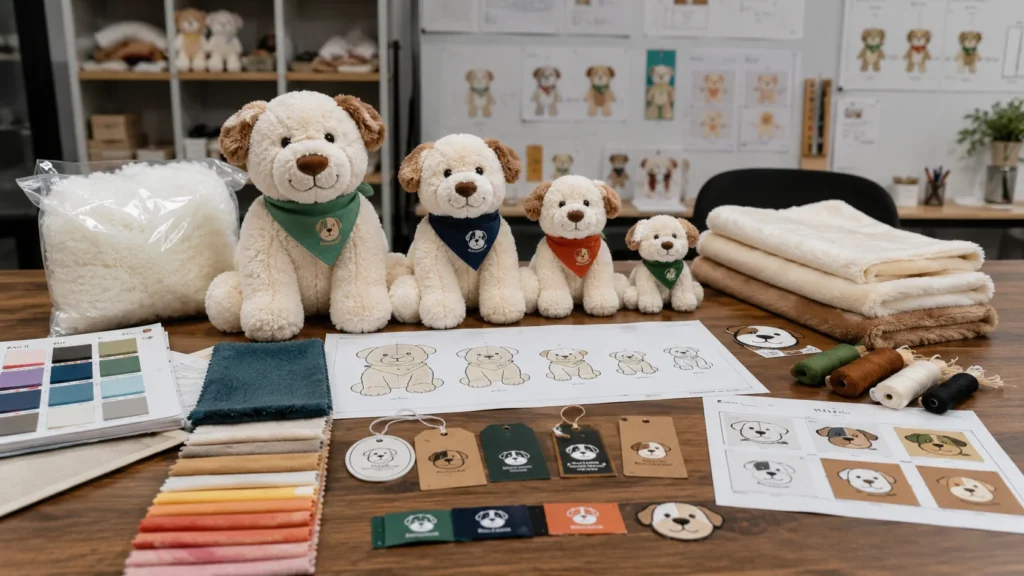
Custom plush toys are not standard shelf products. They usually require special materials, cutting patterns, embroidery files, sample development, production setup and quality control.
MOQ can vary because of:
- Fabric availability
- Fabric color requirements
- Toy size
- Design complexity
- Number of styles
- Embroidery details
- Printing method
- Logo customization
- Accessories
- Packaging
- Testing requirements
- Production schedule
A simple plush keychain may have a different MOQ from a 30 cm custom mascot plush. A standard animal plush may have a different MOQ from a fully custom character plushie collection.
For custom manufacturing, buyers should not only ask “What is your MOQ?” They should also explain the product clearly so the supplier can give a realistic answer.
Common MOQ Ranges for Plush Toys and Plushies
MOQ can vary by supplier and project. The following ranges are only general references for B2B buyers.
| Product Type | Common MOQ Situation |
|---|---|
| Simple plush keychains | Lower MOQ may be possible for simple designs |
| Standard stuffed animals | MOQ depends on size, fabric and embroidery |
| Custom plush mascots | Usually needs sample development and style-based MOQ |
| Collectible plushies | MOQ may depend on number of designs in the collection |
| Christmas plush toys | Seasonal timing and material planning can affect MOQ |
| Plush pillows | Larger size may affect packing and shipping cost |
| Fully custom character plush | More design work and sampling may be required |
Buyers should always confirm whether the MOQ is:
- Per design
- Per color
- Per size
- Per packaging style
- Per total order
This detail is very important when comparing supplier quotes.
When asking about MOQ, do not only ask for one number. Ask whether the MOQ applies to each design, each size, each color or the total order.
Factors That Affect MOQ
Many factors can change the MOQ for custom plush toys.
1. Product Size
Small plushies and plush keychains may use less fabric and filling, but they can require more detailed sewing work. Larger plush toys may use more material and increase packing volume.
Size affects:
- Material usage
- Cutting pattern
- Filling quantity
- Packaging size
- Carton volume
- Shipping cost
2. Fabric Type
Common plush fabrics include short plush, super soft plush, velboa, fleece, faux fur and printed fabric.
If the fabric is common and available, MOQ may be easier to manage. If the buyer needs a special fabric color or texture, the fabric supplier may have its own MOQ.
3. Number of Colors
More colors may require more fabric sourcing, cutting and production management.
A plush toy with two fabric colors is usually easier than a plush toy with eight different fabric colors.
4. Embroidery and Printing
Face details, logos, patterns and decorations can be made by embroidery, printing or appliqué.
Embroidery can improve quality but may require setup files and sample testing. Printing may be suitable for some designs, but it depends on fabric type and artwork.
5. Accessories
Accessories can include:
- Keyrings
- Clothing
- Scarves
- Hats
- Bags
- Labels
- Buttons
- Ribbons
- Small decorative parts
More accessories usually mean more sourcing and assembly work.
6. Packaging
Packaging can also affect MOQ, especially if it is fully customized.
Common plush packaging options include:
- Polybag
- Hang tag
- Header card
- Display box
- Gift box
- Window box
- Barcode label
- Retail display tray
For more packaging details, you can read our guide on custom product packaging from China.
Sample Order vs Bulk Order
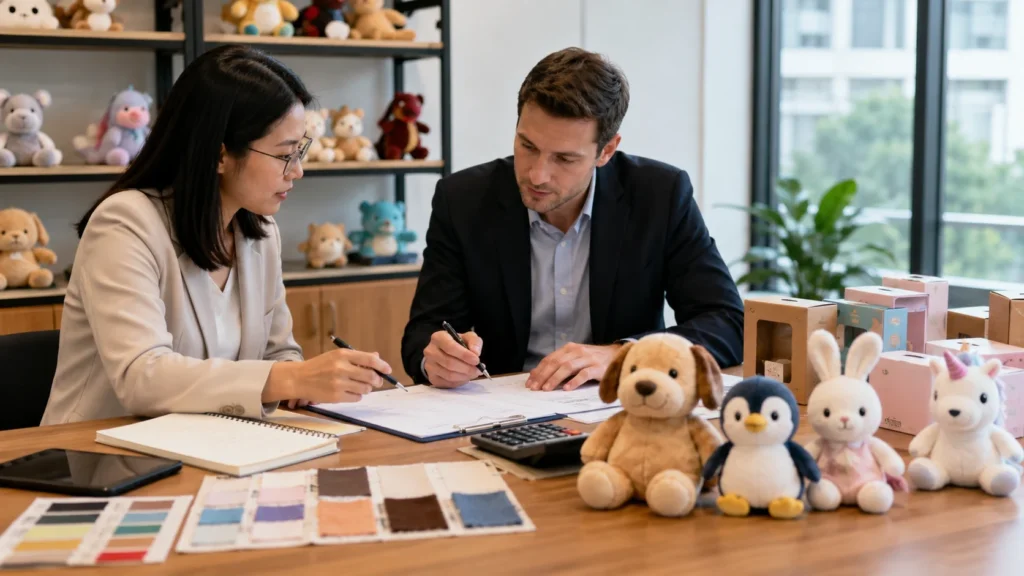
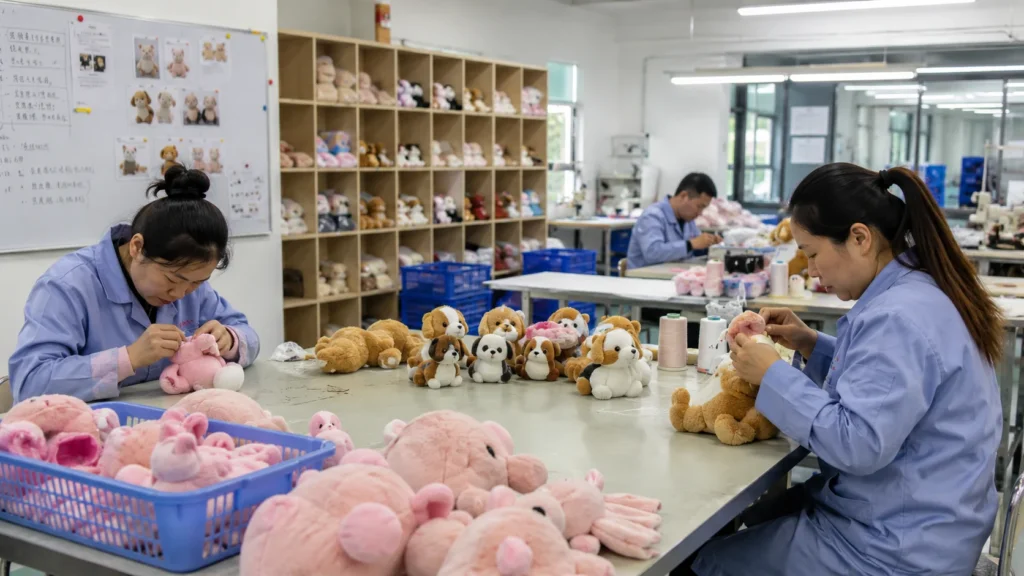
For custom plush toys, the first step is usually sample development. A sample order is different from a bulk order.
Sample Order
A sample is made to confirm the design before mass production.
Sample development may include:
- Pattern making
- Fabric selection
- Embroidery testing
- Shape adjustment
- Face expression adjustment
- Size confirmation
- Label and tag checking
- Packaging review
The sample cost is usually higher per piece because it includes development work, not only material cost.
Bulk Order
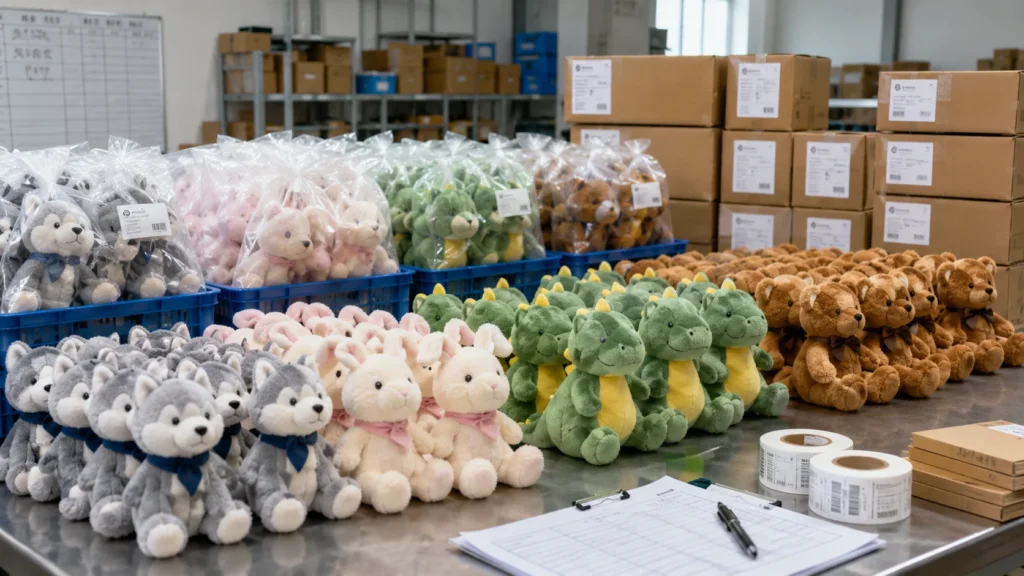
Bulk production starts after the sample is approved.
Bulk production includes:
- Material purchasing
- Cutting
- Sewing
- Embroidery or printing
- Filling
- Finishing
- Quality checking
- Packaging
- Carton packing
The unit price is usually lower in bulk production because the setup cost is spread across more units.
How Logo and Packaging Customization Affect MOQ
Logo and packaging requirements can affect MOQ because they often involve additional production steps.
Logo options include:
- Embroidered logo
- Printed logo
- Woven label
- Care label
- Hang tag
- Paper card
- Header card
- Packaging sticker
- QR code label
- Barcode label
Packaging options include:
- Simple polybag
- Custom hang tag
- Retail header card
- Custom gift box
- Display box
- Window box
- Set packaging
A simple hang tag may be easier to manage than a fully custom gift box. A woven label may have its own MOQ. A custom printed box may require a minimum print quantity.
Buyers should confirm logo and packaging requirements early, not after the plush sample is finished.
How Retail Chains Should Plan Plushie Collection Quantities
Retail chains and supermarkets often plan plushie collections instead of one single plush toy. In this case, MOQ planning becomes more important.
For example, a buyer may want:
- 6 plushie characters
- 2 sizes
- Custom hang tags
- Barcode labels
- Display boxes
- Delivery before a campaign date
In this situation, the supplier needs to calculate:
- MOQ per character
- Total order quantity
- Fabric usage
- Packaging quantity
- Production schedule
- Packing volume
- Shipment timing
Retail buyers should estimate how the plushies will be used:
| Campaign Type | Quantity Planning |
|---|---|
| Gift-with-purchase | Estimate based on expected customer participation |
| Retail sale | Estimate by store count and shelf space |
| Loyalty program | Estimate based on redemption target |
| Seasonal campaign | Estimate based on campaign period |
| Test order | Start with fewer designs or smaller rollout |
A good strategy is to start with a focused collection, then expand after testing customer response.
How to Request an Accurate MOQ and Price
To get an accurate MOQ and price, buyers should provide enough project details.
Useful information includes:
- Product type
- Reference image
- Design sketch
- Target size
- Quantity
- Number of styles
- Fabric preference
- Logo requirements
- Packaging requirements
- Target market
- Safety requirements
- Delivery deadline
- Shipping destination
- Target price range
- Whether a sample is needed
A vague message like “Please send price for plush toy” is difficult for a supplier to quote accurately.
A better message is:
“We need six collectible plushies for a supermarket campaign. Each plushie is about 15 cm. We need custom hang tags, barcode labels and bulk delivery to Romania. Please advise MOQ, sample cost, production time and packaging options.”
This kind of message helps the supplier provide more useful answers.
Common Buyer Mistakes
Buyers often make these mistakes when asking about MOQ for custom plush toys:
- Asking for price without product size
- Not explaining whether the design is custom or standard
- Not confirming quantity per design
- Forgetting packaging requirements
- Ignoring fabric availability
- Not allowing enough time for sample development
- Comparing prices without comparing quality
- Not confirming safety or testing requirements
- Changing details after quotation
- Waiting too close to the delivery deadline
A good quotation depends on clear project information.
How to Reduce Risk for a First Custom Plush Order
If this is your first custom plush project, you can reduce risk by starting with a manageable plan.
Helpful strategies include:
- Start with one or a few designs
- Choose common fabric options
- Avoid too many small accessories
- Use simple packaging for the first order
- Confirm sample before production
- Plan enough time for revisions
- Discuss target price early
- Confirm quality points clearly
- Use a phased order plan if needed
For retail chains, a small pilot campaign may help test customer response before expanding to a larger plushie collection.
If you are comparing suppliers before your first order, you can also read our China sourcing partner checklist.
How Superstar Supports Flexible Plush Toy Projects
Superstar helps overseas buyers develop custom plush toys, plushies, stuffed animals, plush mascots, plush keychains and plush gift products from China.
We can support:
- Product idea discussion
- MOQ and quantity planning
- Material suggestions
- Sample development
- Size and structure options
- Logo and label coordination
- Packaging suggestions
- Quality checking
- Production communication
- Shipment preparation
For buyers who need several product categories in one project, our one-stop sourcing from China service can help coordinate suppliers, packaging and logistics.
If your project is based on a brand character or event mascot, you can also read our guide on custom plush mascots for brands and events.
For broader plush development ideas, you can also read our guide on custom plushies for retail chains.
FAQ
What is MOQ for custom plush toys?
MOQ means minimum order quantity. For custom plush toys, it may apply to one design, one size, one color, one style or one production batch. The exact MOQ depends on the product design and customization details.
Why is MOQ different for different plush toys?
MOQ can vary because of fabric availability, design complexity, size, embroidery, printing, accessories, packaging and the number of styles in the order.
Can I order a sample before bulk production?
Yes. For custom plush toys, sample development is usually the first step. The sample helps confirm shape, fabric, size, expression, logo and packaging before mass production.
Does custom packaging affect MOQ?
Yes. Custom packaging such as gift boxes, display boxes, header cards or printed labels may have its own MOQ, depending on the packaging supplier and printing method.
What information should I provide to get an accurate MOQ?
u003cbru003eYou should provide product type, size, quantity, design reference, number of styles, fabric preference, logo requirements, packaging requirements, target market and delivery deadline.
Can Superstar help with custom plush toy MOQ planning?
Yes. Superstar can help buyers review project details, suggest suitable materials and packaging, explain MOQ factors and support custom plush toy production from sample to shipment.
Need MOQ and Pricing for Custom Plush Toys?
Send us your plush toy idea, size, quantity, reference image or packaging requirements. Superstar can help review your project and provide suitable MOQ, sample and production suggestions.