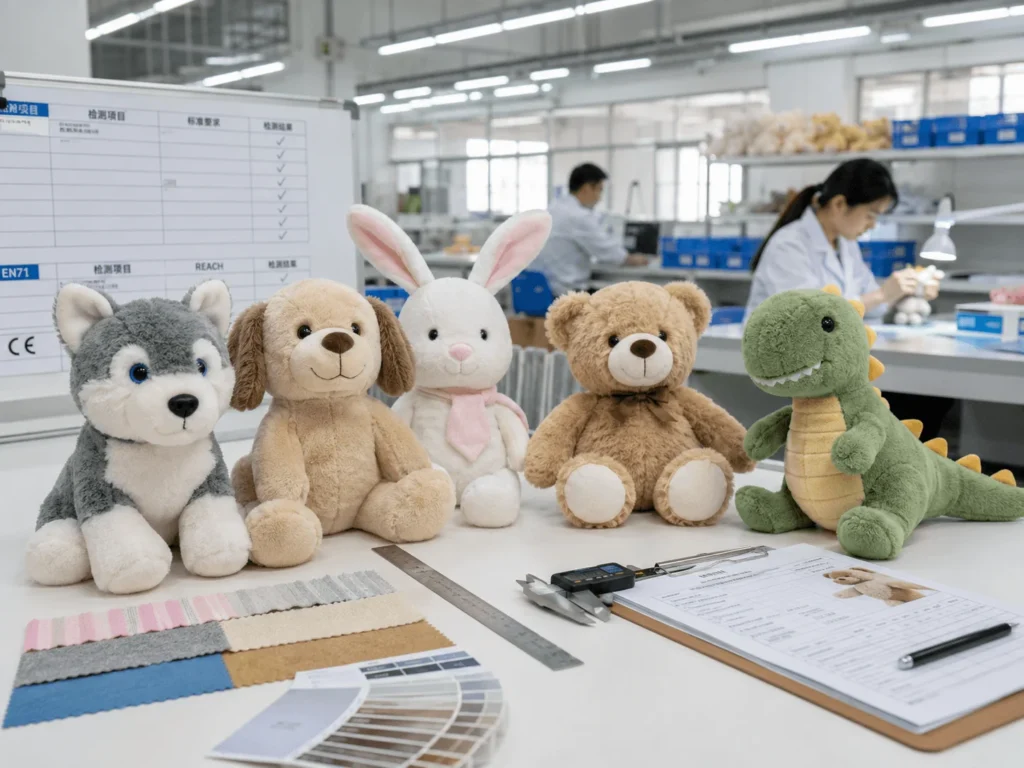
Custom plush toy compliance is one of the most important steps for EU brands, retailers, importers and promotional gift companies before launching a new plush toy project. Developing a custom plush toy is not only about creating a cute design — it also requires careful attention to safety standards, testing, labeling and documentation.
When importing plush toys from China, buyers often need to consider EU toy safety requirements such as EN71, CE marking and REACH, as well as market-specific requirements for the US, UK or other regions.
At Superstar Creation, we help global buyers develop custom plush toys with attention to materials, sampling, quality control, testing coordination and production follow-up. This guide explains the key compliance points importers should understand before starting a custom plush toy project.
Quick Summary
In this guide, you will learn:
- Why plush toy compliance matters for EU brands
- What EN71, CE marking and REACH mean for custom plush toys
- Common compliance risks in plush toy development
- How to manage testing, reports, labels and documents
- What buyers should prepare before starting a custom plush toy project
- How Superstar Creation can support safer custom plush toy production
Why Plush Toy Compliance Matters for EU Brands
Plush toys are often designed for children, which means safety requirements are much stricter than for ordinary gift products. A non-compliant toy may cause serious problems, including customs rejection, product recalls, sales restrictions, financial loss and damage to brand reputation.
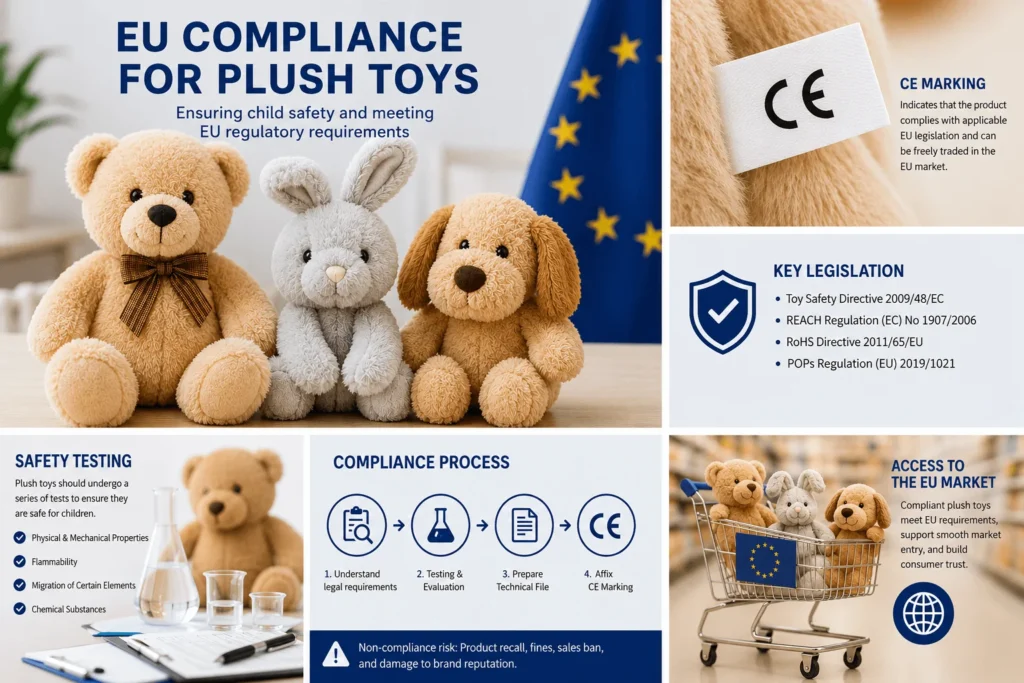
For EU buyers, compliance is especially important because toy products must meet the requirements of the EU Toy Safety Directive and applicable harmonised standards. In many cases, EN71 testing is used to verify mechanical, physical, flammability and chemical safety requirements for toys.
For B2B buyers, safety compliance is not just a legal requirement. It is also part of building trust with parents, retailers, distributors and brand partners.
Key compliance areas usually include:
- Mechanical and physical safety: such as seams, small parts, sharp points, cords, accessories and detachable components.
- Flammability: especially important for plush fabrics, costumes and soft materials.
- Chemical safety: including restricted substances in fabrics, stuffing, dyes, coatings and accessories.
- Labeling and traceability: such as age grading, warnings, manufacturer/importer information and batch identification.
- Market-specific documentation: such as test reports, technical files, declarations and certificates required by the target market.
Compliance should be considered before sampling and mass production. Changing materials, accessories or structure after sample approval may affect testing results and market compliance.
Key EU Standards and Regulations for Custom Plush Toys
Before starting sampling or testing, buyers should understand the main compliance requirements that usually apply to plush toys.
| Topic | Why It Matters for Plush Toys |
|---|---|
| EN71-1 | Mechanical and physical safety, including small parts, seams, sharp points and product structure |
| EN71-2 | Flammability requirements for plush fabrics and soft materials |
| EN71-3 | Migration of certain elements and chemical safety concerns |
| CE Marking | Indicates that the responsible party has completed the applicable conformity process |
| REACH | Controls restricted chemical substances in materials, coatings, dyes and accessories |
| ASTM / CPSIA | Important for plush toys intended for the US market |
EN71 Toy Safety Standards
EN71 is one of the most important toy safety standard series for products sold in the European market. For many plush toys, the most commonly relevant parts include:
- EN71-1: Mechanical and physical properties
- EN71-2: Flammability
- EN71-3: Migration of certain elements
The exact testing requirements depend on the product design, age grading, materials, accessories and intended use. A simple plush teddy bear and a plush toy with sound modules, plastic accessories or long cords may have different testing considerations.
CE Marking
CE marking is required for toys sold in the EU. It is not simply a decorative label or a third-party certificate. It is part of a conformity process, where the responsible party confirms that the toy meets applicable EU safety requirements.
After the product passes the required tests and the technical documentation is prepared, the CE mark and required safety information can be applied to the product label, packaging or accompanying documents according to applicable EU requirements.
CE marking should be supported by proper testing, documentation and product information. It should not be treated as only a printed symbol on packaging.
REACH
REACH is related to chemical safety in the EU market. For plush toys, buyers should pay attention to restricted substances that may appear in fabrics, dyes, coatings, printing, plastic accessories, metal parts or packaging materials.
Before mass production, it is important to confirm that selected materials are suitable for the target market and can support the required testing.
ASTM F963 and CPSIA for the US Market
If your plush toys are also intended for the United States, EU compliance alone is not enough. The US has its own requirements, including ASTM F963 and CPSIA. CPSC states that ASTM F963 covers a wide variety of toy safety requirements, and firms need to identify which parts apply to their specific product.
For US buyers, children’s product testing, tracking labels and related documentation may also be required depending on the product.
Common Compliance Risks in Custom Plush Toy Development
Custom plush toys often involve new shapes, new fabrics, special colors, embroidery, plastic parts, sound modules, accessories or branded packaging. These custom details can create compliance risks if they are not reviewed early.
Common risk points include:
1. Small Parts and Detachable Accessories
Eyes, buttons, bows, keyrings, zippers, plastic accessories and decorative parts must be carefully checked. If small parts detach during use, they may create choking hazards for young children.
2. Weak Seams or Poor Stuffing Control
Plush toys must be durable enough for normal use. Weak seams may expose stuffing or small internal parts. During sampling and production, seam strength and stuffing consistency should be checked carefully.
3. Unsafe or Unverified Materials
Soft fabrics, printed materials, fillings, ribbons and accessories may contain restricted substances if the supplier does not control material sources properly. Buyers should avoid changing materials during production without confirming compliance impact.
4. Incorrect Age Grading
A toy designed for children under 36 months may face stricter requirements than a product intended for older children or decorative use. Age grading should be considered from the design stage, not after production.
5. Incomplete Labeling
A compliant plush toy may still face problems if labels, warnings, batch information or importer details are incomplete. Labeling should be reviewed before final production and packaging.
Some buyers assume that a previous test report can automatically cover a new plush toy design. In reality, design, material, accessory or size changes may require a new review or additional testing.
How Superstar Supports Safer Custom Plush Toy Projects
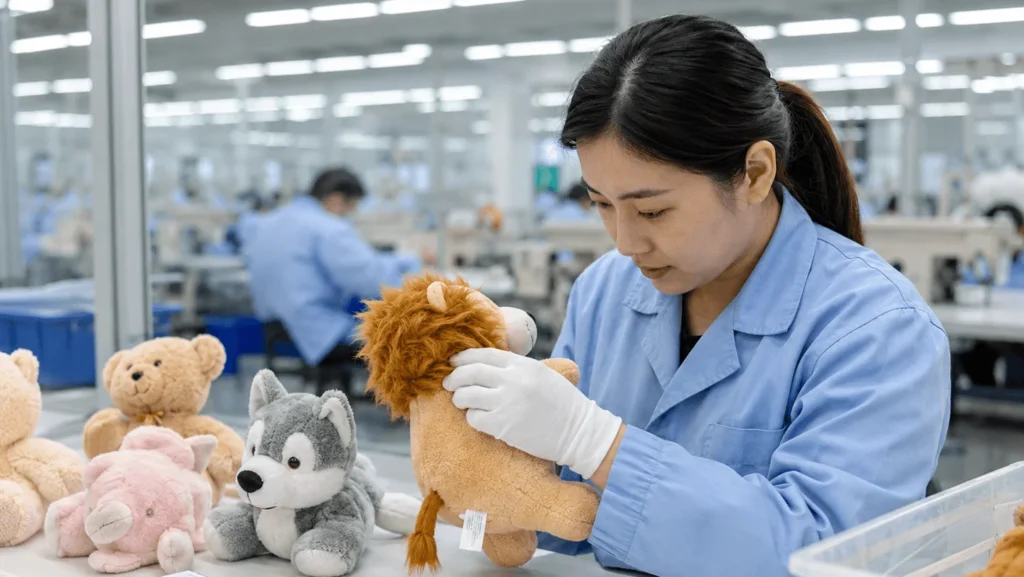
At Superstar Creation, our role is not only to help customers produce plush toys. We also help buyers reduce risks during product development, sampling, production and shipment preparation.
Our support usually includes:
Material Selection Support
We help customers choose suitable fabrics, stuffing, embroidery methods, accessories and packaging materials based on the project requirements and target market.
Sample Development
Before mass production, we develop samples based on the customer’s design, reference image or product concept. The sample stage helps confirm shape, size, color, texture, structure, accessories and overall quality.
Production Follow-up
Once the sample is approved, we follow up with the production process and keep customers updated. If there are changes in material, size, color or construction, we help review the impact before proceeding.
Quality Control
Our QC team conducts production checks and final inspections based on agreed quality standards before shipment. When required by the project, more detailed inspection arrangements can also be discussed.
Testing Coordination
We can help coordinate testing with independent third-party laboratories such as SGS, Intertek, Bureau Veritas or other recognized testing providers according to the buyer’s market requirements.
For a project-specific overview of EU, UK and US testing, reports and supporting documents, visit our Custom Plush Toy Certificates & Testing page.
Recommended Testing and Compliance Process
For custom plush toy projects, we recommend handling compliance step by step instead of waiting until the end of production.
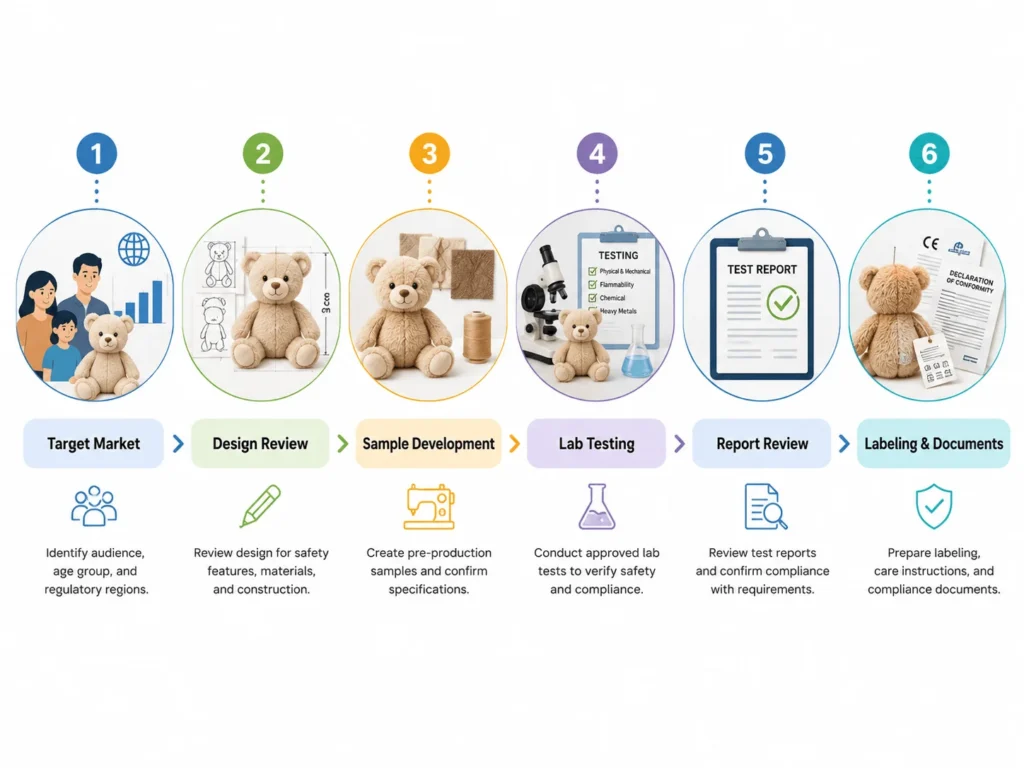
Step 1: Confirm Target Market and Product Use
Before starting development, buyers should confirm where the product will be sold and who the product is intended for. EU, US, UK and other markets may have different requirements.
Important questions include:
- Will the product be sold in the EU?
- Is it intended for children under 36 months?
- Is it a toy, promotional gift or decorative item?
- Will it include small accessories, sound modules or batteries?
- Does the buyer need retail packaging or only bulk packaging?
If you are developing brand characters or event merchandise, you can also read our guide on custom plush mascots for brands and events.
Step 2: Review Design and Material Risks
The design should be reviewed before sampling. Some design elements may look attractive but create safety risks or increase testing complexity.
Examples include:
- Loose accessories
- Long cords or ribbons
- Small detachable parts
- Glitter, coatings or special printing
- Multiple fabric types
- Plastic or metal components
Step 3: Develop a Production-grade Sample
A production-grade sample should use the same or equivalent materials planned for mass production. This helps ensure the test result reflects the final product more accurately.
Step 4: Arrange Laboratory Testing
After the sample is confirmed, testing can be arranged according to the target market requirements. Testing time may vary depending on product complexity and laboratory schedule, but many standard toy tests are completed within several working days after the lab receives the sample.
Step 5: Review the Report and Make Adjustments if Needed
If the sample does not pass a certain test, the product design, materials or construction may need to be adjusted. This is why testing before mass production is important.
Step 6: Prepare Labels, Packaging and Documents
After testing and confirmation, labels and packaging should be prepared according to the buyer’s market requirements. This may include CE marking, age warnings, importer information, batch codes and other required information.
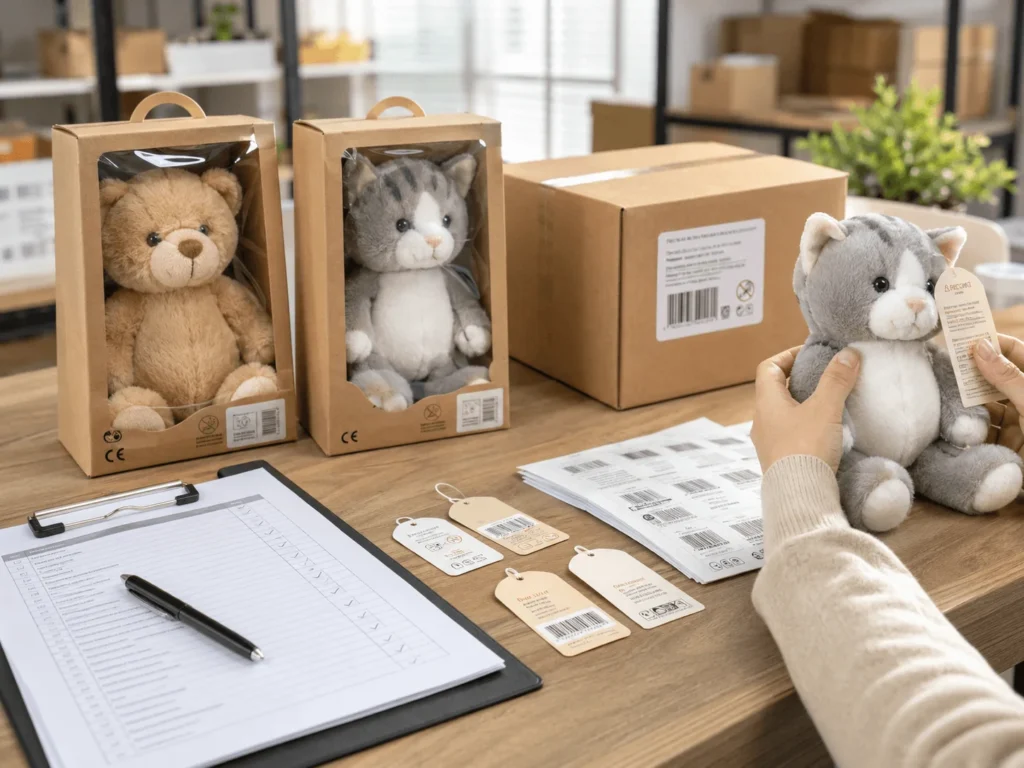
What Buyers Should Prepare Before Starting a Custom Plush Toy Project
To make the development process smoother, buyers should prepare as much information as possible before requesting a quotation or sample.
Buyer Preparation Checklist
| Information to Prepare | Why It Helps |
|---|---|
| Product design file, sketch or reference image | Helps the supplier understand the shape, character and style |
| Target size | Affects material use, cost, packaging and safety review |
| Intended market | Determines testing, labeling and compliance requirements |
| Target age group | Affects safety requirements and risk assessment |
| Expected quantity | Helps evaluate MOQ, production method and pricing |
| Preferred material or texture | Helps confirm material options and testing needs |
| Logo or branding requirements | Helps plan embroidery, printing, labels or hang tags |
| Packaging requirements | Affects retail presentation, labeling and shipping safety |
| Compliance or testing requirements | Helps prepare the correct testing plan |
| Target price range | Helps balance design, material and production cost |
| Desired delivery timeline | Helps plan sampling, testing, production and shipping |
If you are planning a retail plushie collection, our guide on custom plushies for retail chains can help you plan characters, packaging and production before compliance testing.
The more details you provide at the beginning, the easier it is to prepare a suitable solution and avoid unnecessary revisions later.
FAQ
Do plush toys need CE marking in the EU?
Yes. Toys sold in the EU must carry the CE marking. For plush toys, the CE marking should be based on the applicable conformity assessment process and supporting technical documentation.
What parts of EN71 are usually relevant to plush toys?
For many plush toys, EN71-1, EN71-2 and EN71-3 are commonly relevant. However, the exact requirements depend on the design, materials, accessories, age grading and product function.
Do I need a new test report for every plush toy design?
In many cases, a new design or material change may require new testing or at least a compliance review. If the shape, material, accessory or construction changes significantly, buyers should not assume that an old report automatically applies.
Can pre-tested materials reduce compliance risks?
Yes, using materials with existing test history may help reduce risk, but the finished plush toy still needs to be reviewed as a complete product. A material test report does not automatically prove that the final toy design is fully compliant.
How long does plush toy testing usually take?
Testing time depends on the product and the laboratory. For many standard plush toy projects, testing may take several working days after the final sample is ready and submitted.
What information should appear on plush toy labels?
Labels may need to include information such as CE marking, age warnings, product identification, batch or traceability information, manufacturer/importer details and care instructions. Requirements vary by market and product type.
Can one test report cover different colors or sizes?
Sometimes similar variations may be covered under one testing plan, but this depends on the materials, construction and laboratory assessment. Buyers should confirm with the testing provider before relying on one report for multiple versions.
Can you help with testing and documentation?
Yes. Superstar can help coordinate sample preparation, material confirmation, testing communication and basic document support according to the project requirements. The final compliance responsibility should still be reviewed by the responsible importer, brand owner or authorized representative in the target market.
Need Help With a Compliant Custom Plush Toy Project?
Send us your design, reference image or product idea. Our team can help review materials, sampling, testing requirements, labeling and production details before mass production.